
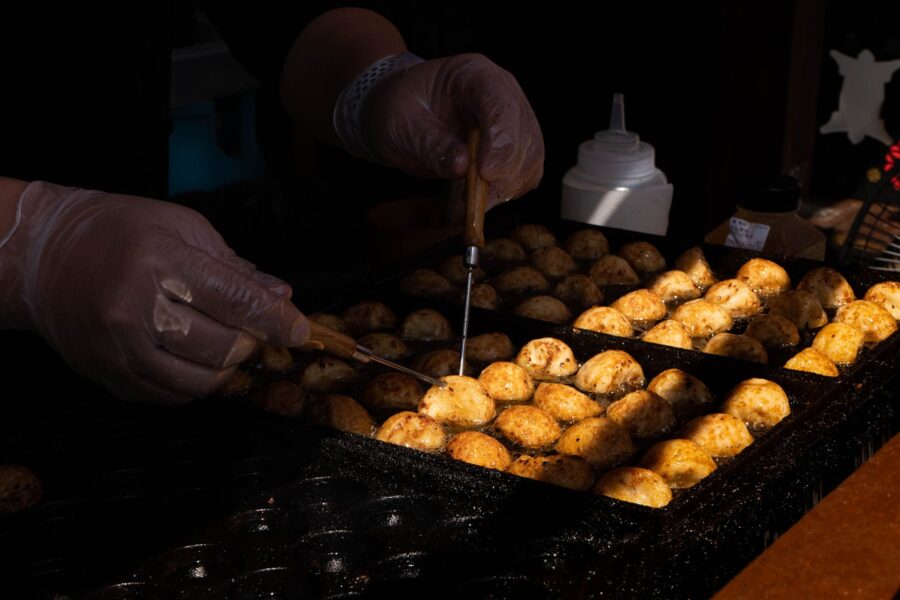
The cook at a takoyaki stall never stops moving. A long steel pick runs around each hollow of the cast-iron plate, catches the edge of a half-set ball and flicks it over, so the raw batter underneath spills into the mold and sets into the other half of the sphere. The plate hisses, the air smells of dashi and hot oil, and the pick clicks on the iron like a typewriter.
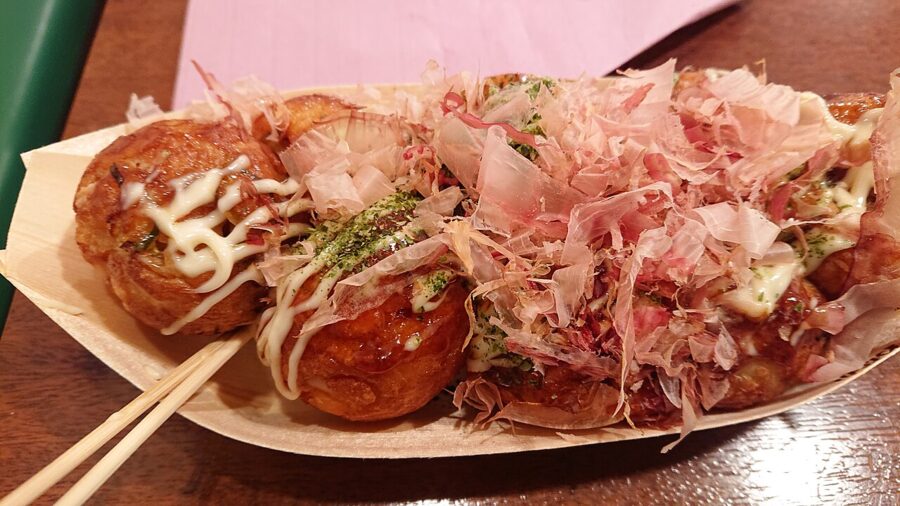
Eight balls go into a paper boat. Sauce goes on with a brush, then a zigzag of mayonnaise, a shake of green aonori seaweed and a fistful of shaved bonito that curls and waves in the steam. The outside is thin and barely crisp; the inside runs like hot sauce around a chunk of octopus.
That is Osaka street food in one boat: flour, water, a hot plate and something from the sea, cheap enough to eat standing up. The city calls the family konamon (粉もん, “flour things”), and it runs from the takoyaki stall to the okonomiyaki griddle and the kushikatsu counter.


Why Osaka eats with a toothpick
Before the war, children in Osaka bought issen yoshoku (一銭洋食, “one-sen Western food”), a thin batter crepe cooked on a hot plate with a few cheap toppings and a splash of sauce. Tokyo had the same snack as monji-yaki or donden-yaki, the second named for the drum the carts beat to call children out. Okonomiyaki, monjayaki and, a little sideways, takoyaki all come from that habit of cheap batter on hot iron.
Osaka kept it in the middle of the city. Takoyaki was sold from stalls at the Tenma Tenjin shrine fairs and in the entertainment districts from the start of the Showa era, and spread across Japan after the war. Konamon fills the slot that onigiri fill elsewhere: a few coins, something hot in the hand, no table. Aizuya, the shop that invented takoyaki, charges from ¥550 (about US$3.50) for twelve now, against ¥400 in 1998.
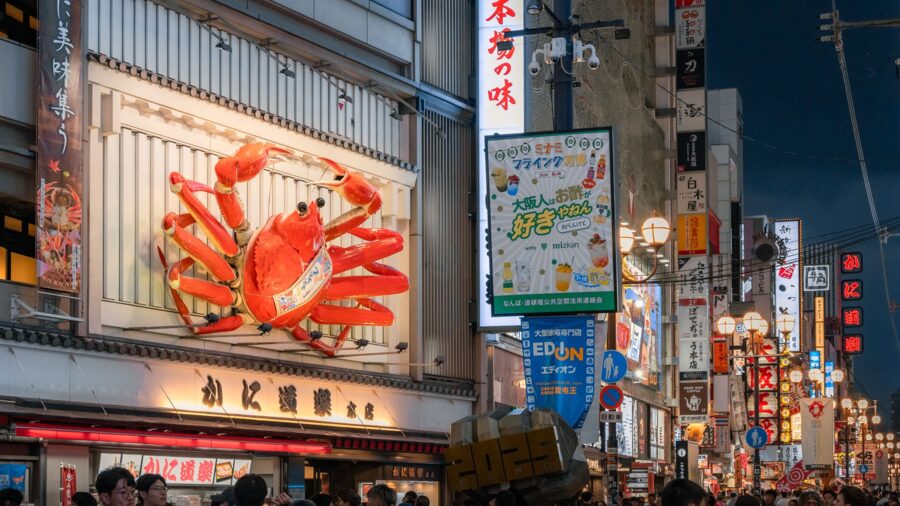
Takoyaki
Aizuya and the ball that started in 1935
Takoyaki has a named inventor. Tomekichi Endo, born in 1907 in Aizubange in Fukushima, opened a stall in Imazato, Osaka, selling rajio-yaki (ラヂオ焼き, “radio-yaki”), small balls of batter with beef and konnyaku inside. He called it Aizuya, after his home region. The shop’s own pages give 1933 for the stall in one place and 1935 for the radio-yaki in another, but agree on what came next.
A customer told him that Osaka put meat in, but Akashi, the octopus port in neighboring Hyogo, used octopus. Endo tried it, seasoned the batter itself with soy and dashi, and in 1935 called the result takoyaki (たこ焼き, “grilled octopus”). Two balls cost one sen.
Aizuya still serves it plain, with nothing on top; vinegar and soy, Worcestershire sauce and chili powder wait on the counter. A small plate of 12 costs from ¥550 as of 2026. Order the plain ones first, then the rajio-yaki, which the shop revived in 2005 after seventy years off the menu.
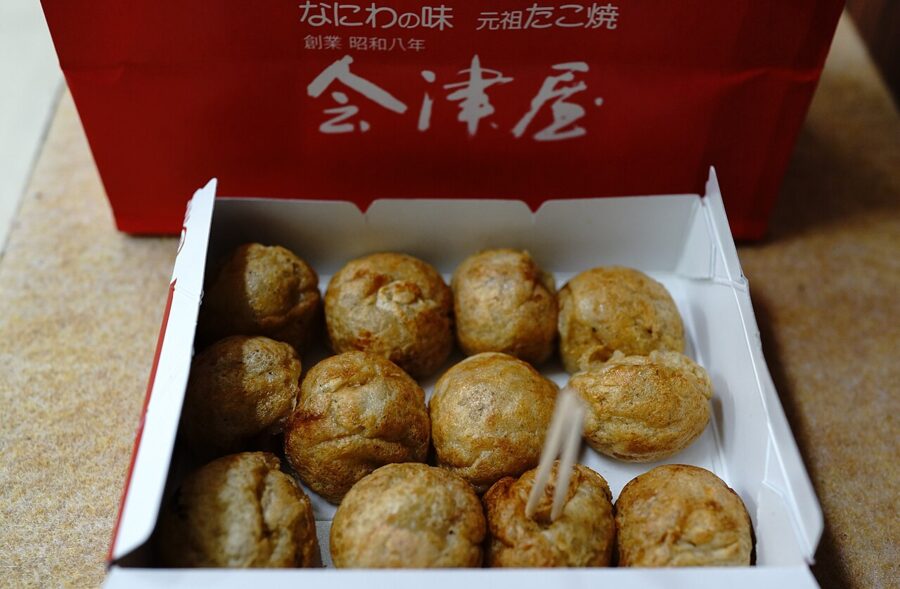

The main shop moved to Tamade, in Nishinari, in 1993. It opens 11am to 9pm, closing only on New Year’s Day, near exit 1 of Tamade Station on the Yotsubashi Line. Aizuya also has counters in Namba, Tennoji, Tengachaya and Umeda.
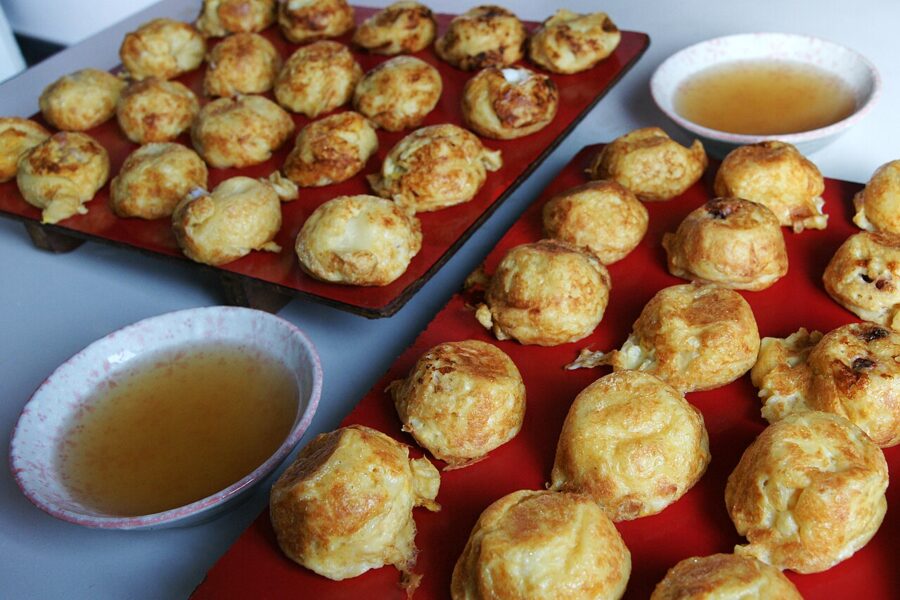

The batter, the octopus and the pan
The batter is wheat flour thinned with water or dashi, far runnier than pancake batter. Into each hollow go a cube of boiled octopus, a pinch of tenkasu (天かす, tempura scraps), green onion and red pickled ginger, with dried shrimp or powdered bonito in some recipes. The plate is iron or copper, cast with rows of half-sphere hollows.
Oil the plate until it smokes, fill each hollow a third of the way, drop in the octopus and tenkasu, then flood the plate until batter runs over the rims. When the edges brown, cut the sheet along the grid with a bamboo pick and turn each ball halfway, tucking the overflow under. Two or three more turns close the sphere.
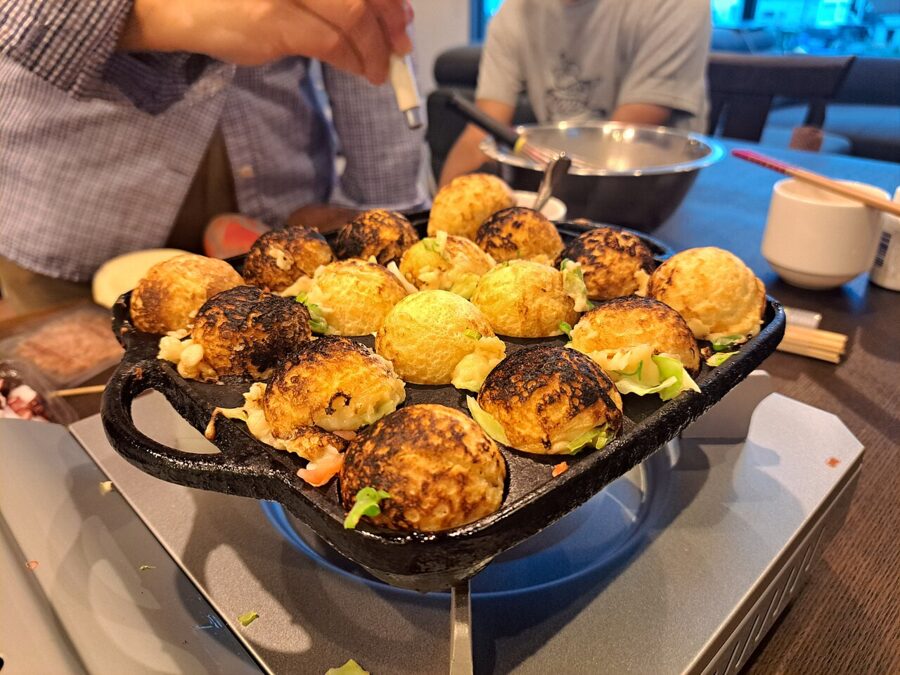
Toppings changed more than the batter. Sauce and mayonnaise came later, from other shops, and now most stalls let you choose. Wanaka offers sauce, kiln-cooked salt, a soy dashi or a spicy sauce, plus tako-pon, dressed with ponzu.
How to eat it without burning your mouth
The center is liquid and very hot. Wait a minute, break the first ball open with a toothpick to let the steam out, then eat it in two bites.
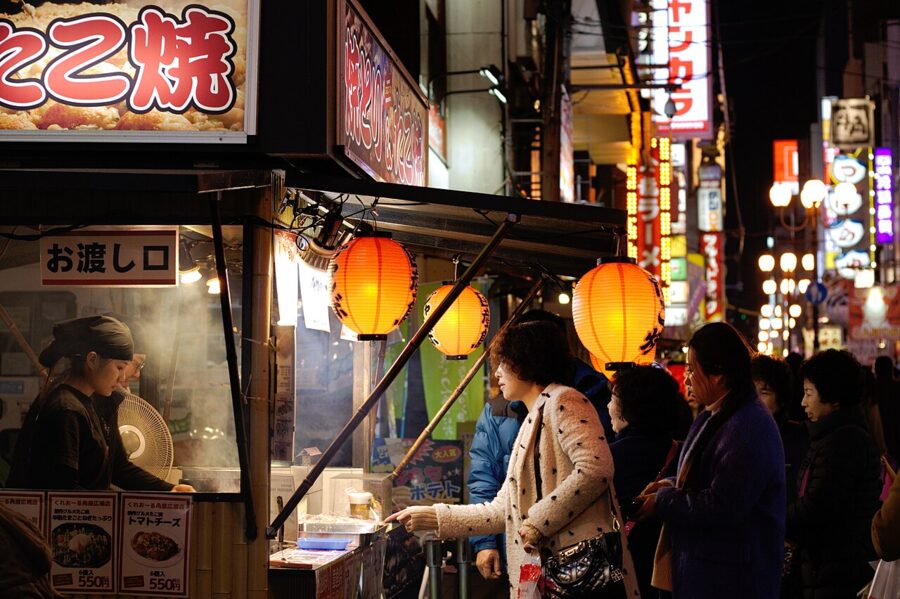
Eat at the stall or a step away from it, because the texture goes quickly: the shell softens and the middle sets. Skip stalls with a pile of finished balls under a lamp, and pick the one turning a fresh plate.
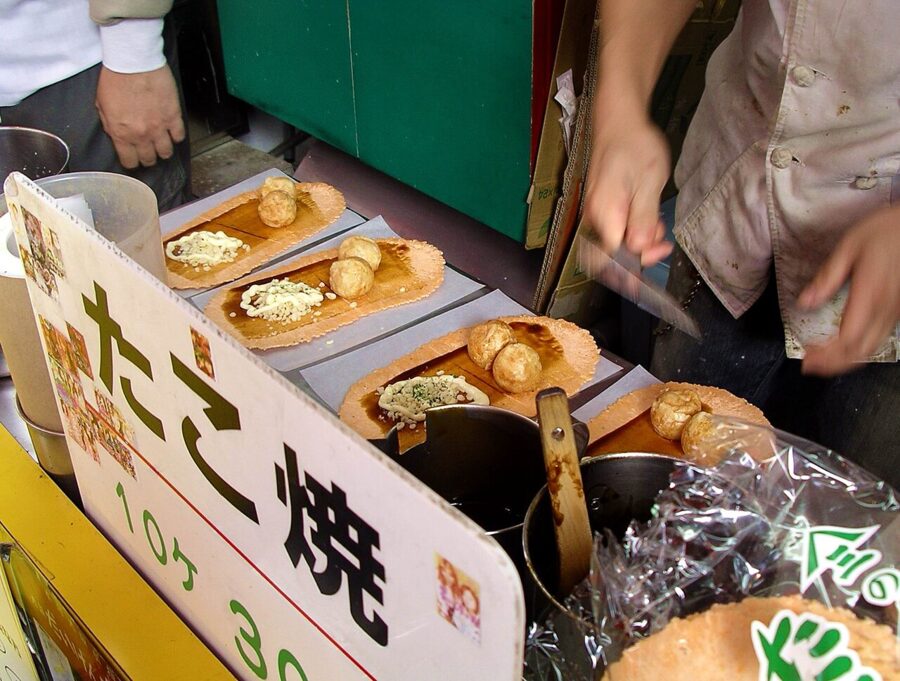

The stalls in Dotonbori, Namba and beyond
Takoyaki Doraku Wanaka (たこ焼道楽 わなか) began as a sushi and sweet shop that started making takoyaki under its eaves. Its main shop at Namba Sennichimae 11-19 is five minutes from exit 3 of Namba Station and takes cash or PayPay. It is one of three Wanaka counters selling wanko-dako, takoyaki in warm dashi, which I would order on a cold night.
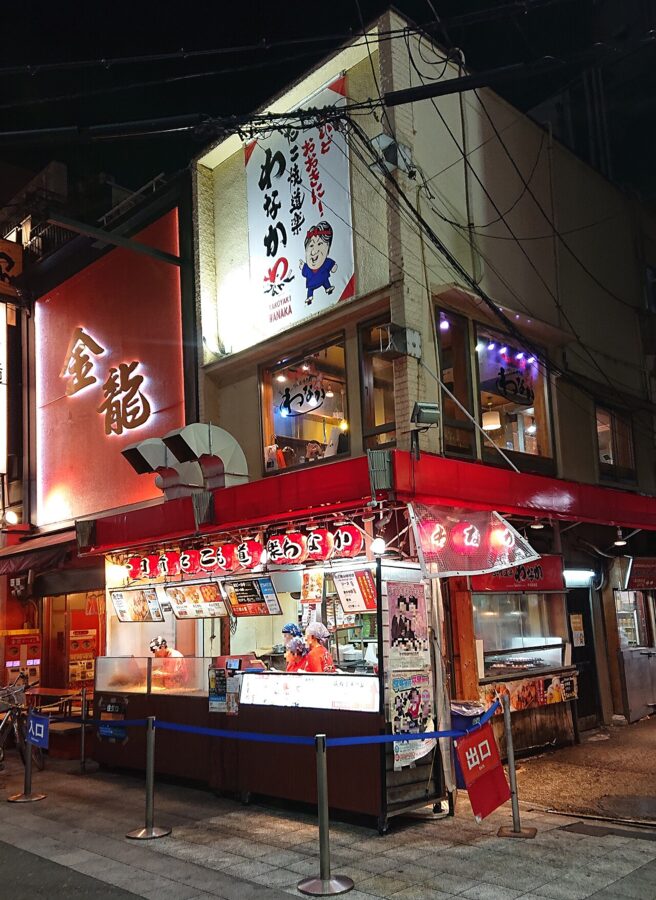

Kukuru (くくる) is the Dotonbori name for a soft, almost molten ball; its specialty is odako takoyaki with extra-large pieces of octopus. Its Konamon Museum building at 1-6-12 Dotonbori adds eat-in seating and displays on konamon history, open 10:30am to 10:30pm on weekdays and from 9am on weekends and holidays, as of 2026.
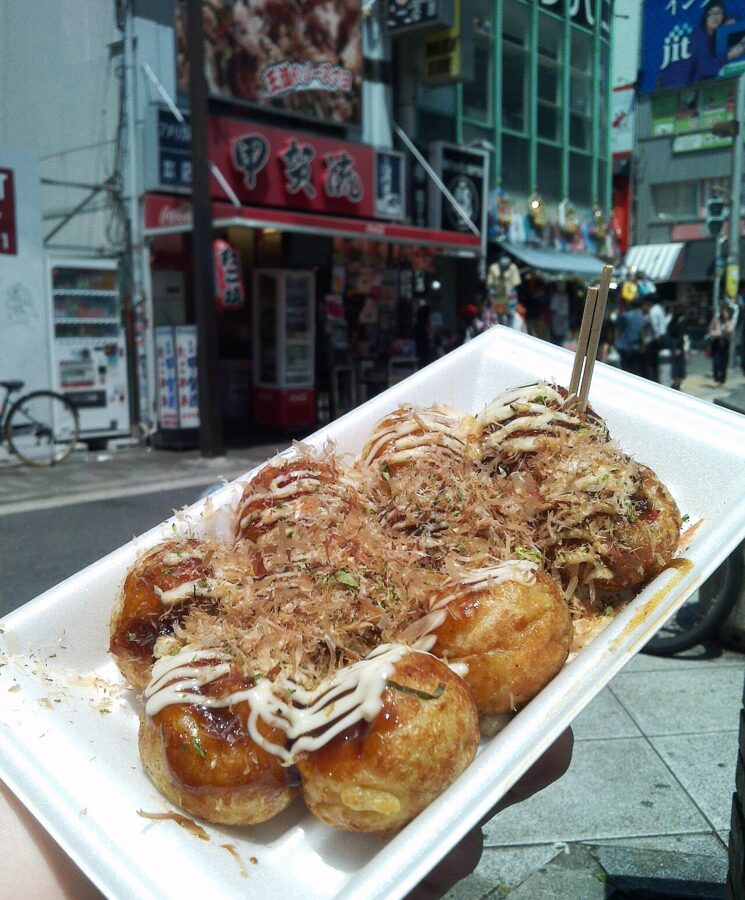

For a side-by-side tasting, the takoyaki hall on the fourth floor of Universal CityWalk Osaka, signed TAKOPA, gathers six Osaka shops: Juhachiban, Aizuya, Tamaya, Abeno Takoyaki Yamachan, Kogaryu and Kukuru. It opens 11am to 10pm, entry is free, and it is a minute from Universal City Station. Taste Aizuya’s plain ball next to Kukuru’s molten one without crossing the city.
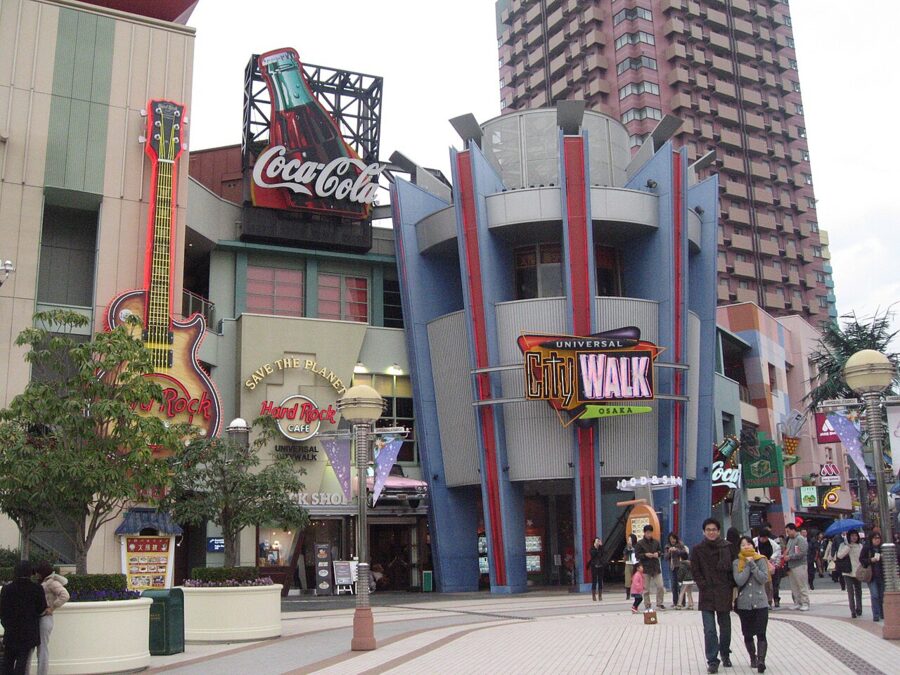

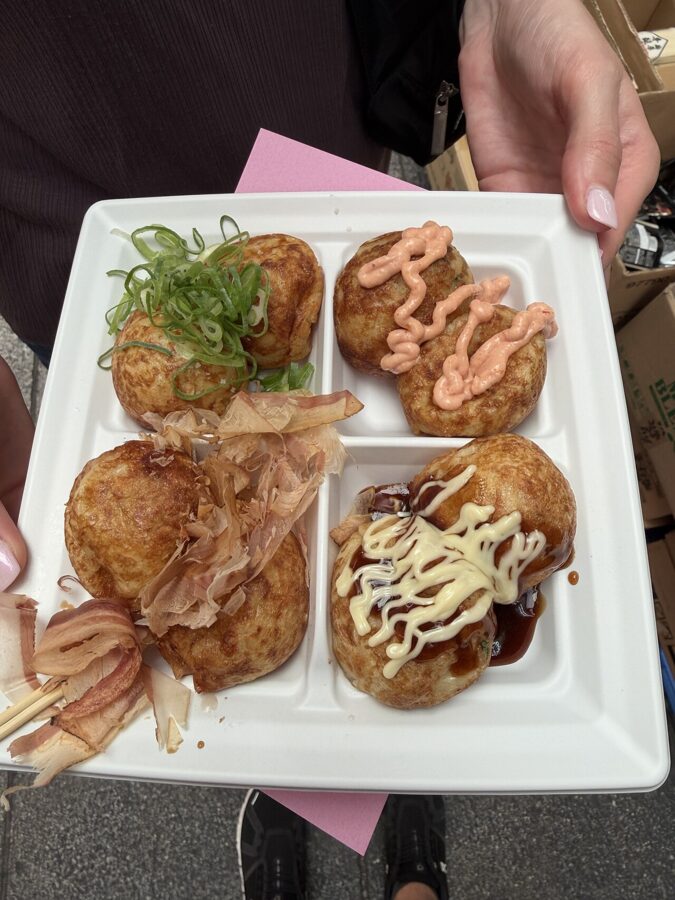

Making it yourself
At the Dotonbori Konamon Museum, Kukuru’s basic takoyaki course costs ¥3,850 (about US$25) as of 2026, including the 15 balls you make, two of Kukuru’s own and a soft drink. A course making a replica food-sample boat costs ¥3,520 (about US$22). Book both online ahead; Aizuya also runs takoyaki classes at its shop.
At home, any Kansai supermarket sells takoyaki flour, sauce and tenkasu, and plates are cheap in homeware stores. Aizuya sells its own flour and a plate made for an Iwatani tabletop burner, with instructions in the box.
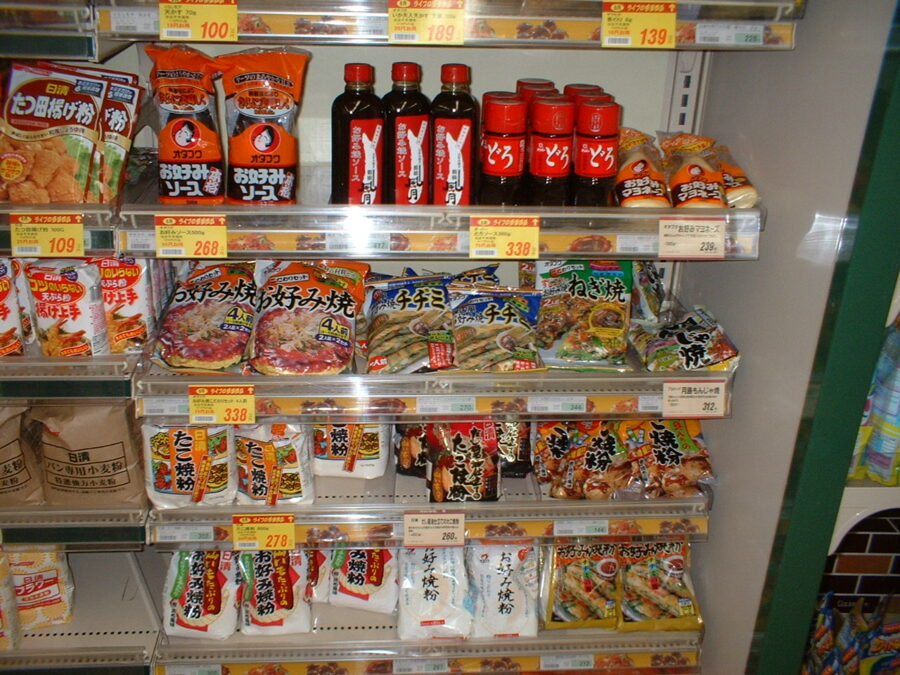

Okonomiyaki
The Osaka way: mix, then cook
Okonomiyaki (お好み焼き, “grilled as you like it”) in Osaka starts in a bowl. Batter loosened with dashi, shredded cabbage, an egg and the filling are mixed, poured onto the griddle as a thick round and turned once. The standard is buta-tama, pork and egg.
It gets the takoyaki finish: sauce, mayonnaise, aonori and bonito. Osaka also eats it as a side dish, which surprises people from Hiroshima; an okonomiyaki teishoku, with rice and miso soup, is an ordinary lunch set.
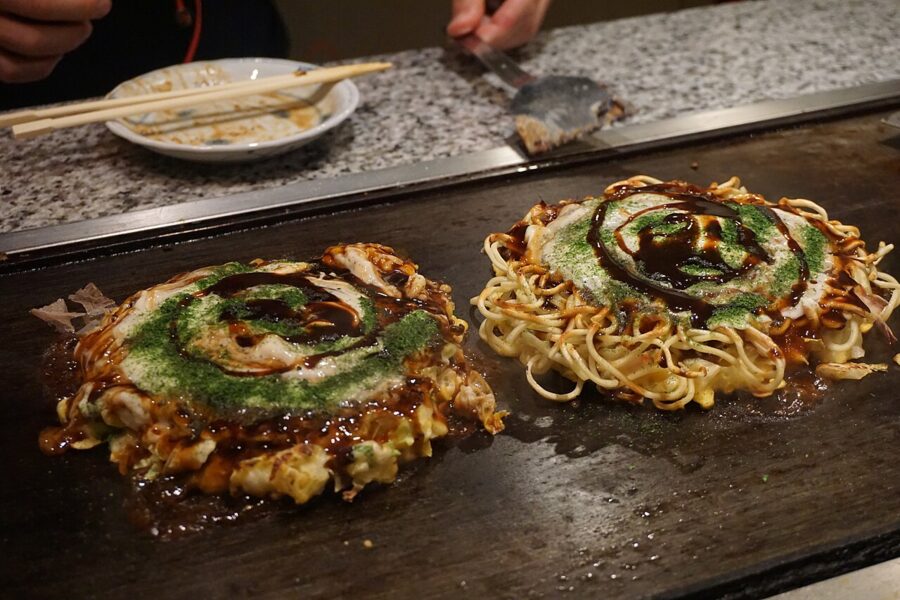

The old names in Minami are a short walk apart. Mizuno (美津の) on Dotonbori, open since 1945, is known for yamaimo-yaki, made with grated mountain yam and no flour. Ajinoya (味乃家) in Namba uses Japanese ingredients, picks its cabbage by season and closes on Mondays. Chibo (千房) opened in Sennichimae in 1973 and is now a national chain with English menus.
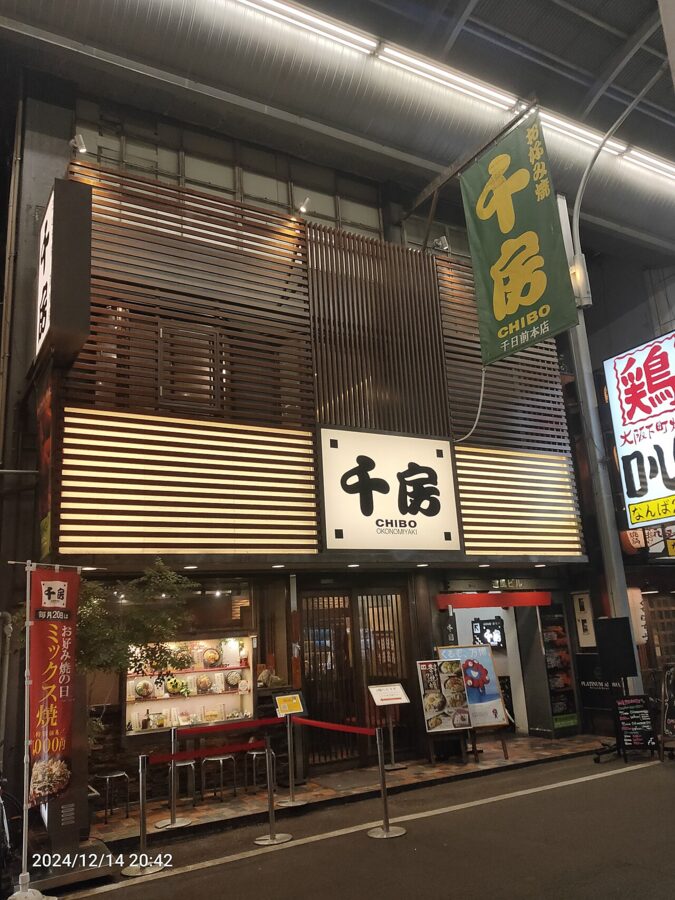

How an okonomiyaki restaurant works
Every table or counter is built around a teppan, a steel griddle heated from below. Some shops cook everything for you; others bring a bowl of raw batter and fillings and leave you to it. Ask, or watch the next table.
To cook your own, stir the bowl well, pour it onto the oiled griddle and shape a round two fingers thick. Leave it for five or six minutes, flip it once with two spatulas, and give it about the same again. Paint on sauce and mayonnaise last.
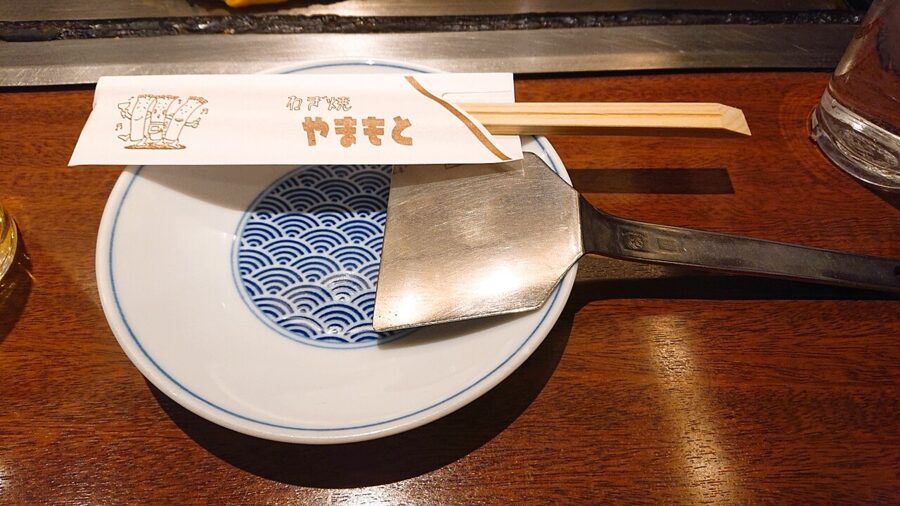

The tool is the kote (コテ, also hera). Practiced Osaka eaters cut a bite with it and eat straight off it, no chopsticks, leaving the okonomiyaki on the hot griddle. Sauce, mayonnaise and often a spicier Worcestershire-style sauce sit on the table. In the evening an okonomiyaki shop runs much like an izakaya, with beer, highballs and griddle dishes ordered as you go.
Modan-yaki and negiyaki
Modan-yaki (モダン焼き, “modern grill”) is okonomiyaki with fried yakisoba noodles cooked in. Botejyu (ぼてぢゅう), founded in 1946, says it invented both modan-yaki and mayonnaise on okonomiyaki. A shop in Nagata, Kobe, has a rival claim, so treat it as Botejyu’s story.
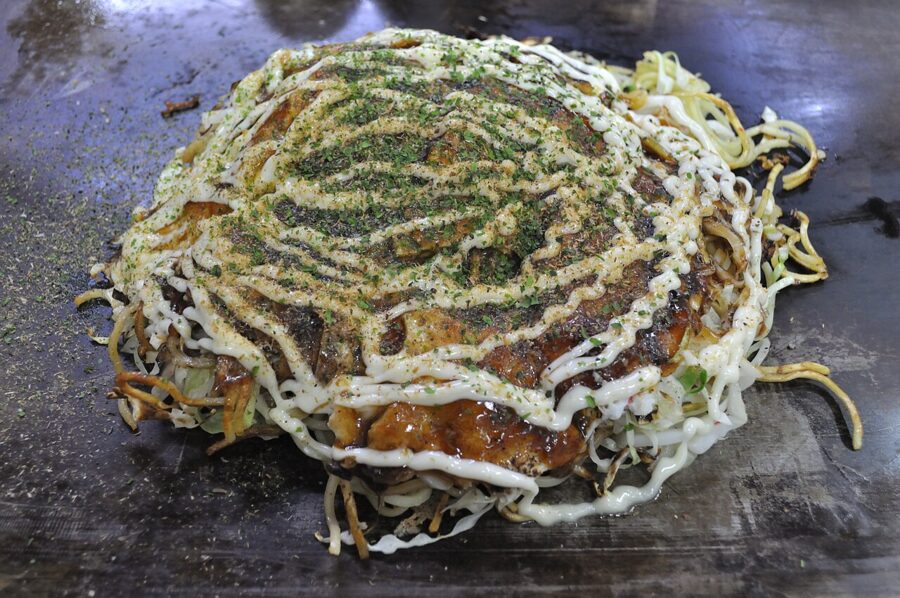
Negiyaki (ねぎ焼き) swaps cabbage for a heap of green onion on a thin batter. Its home is Negiyaki Yamamoto in Juso, which opened in 1965 as an ordinary okonomiyaki shop; the story goes that negiyaki began as a staff meal. The classic is suji-negiyaki, with slow-cooked beef tendon, served with a soy-based seasoning as well as sauce. Juso is one stop from Umeda on the Hankyu lines.

The Hiroshima way: layers
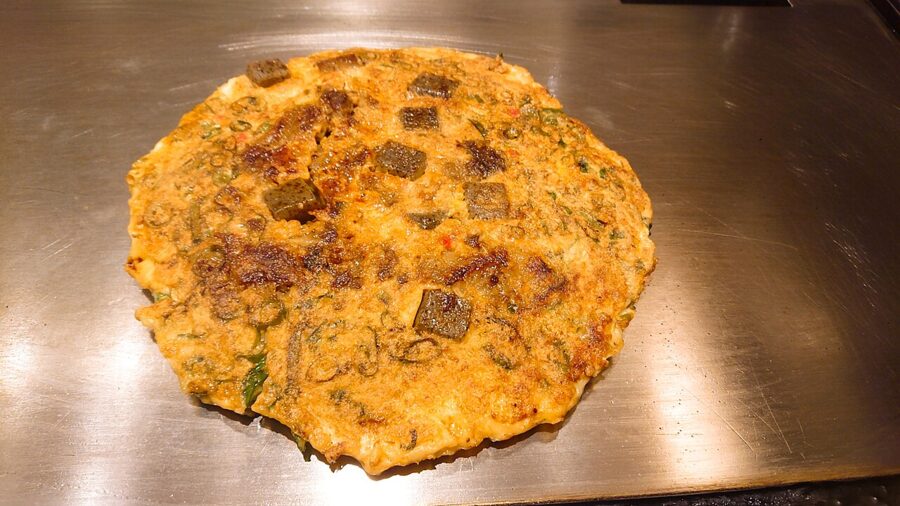
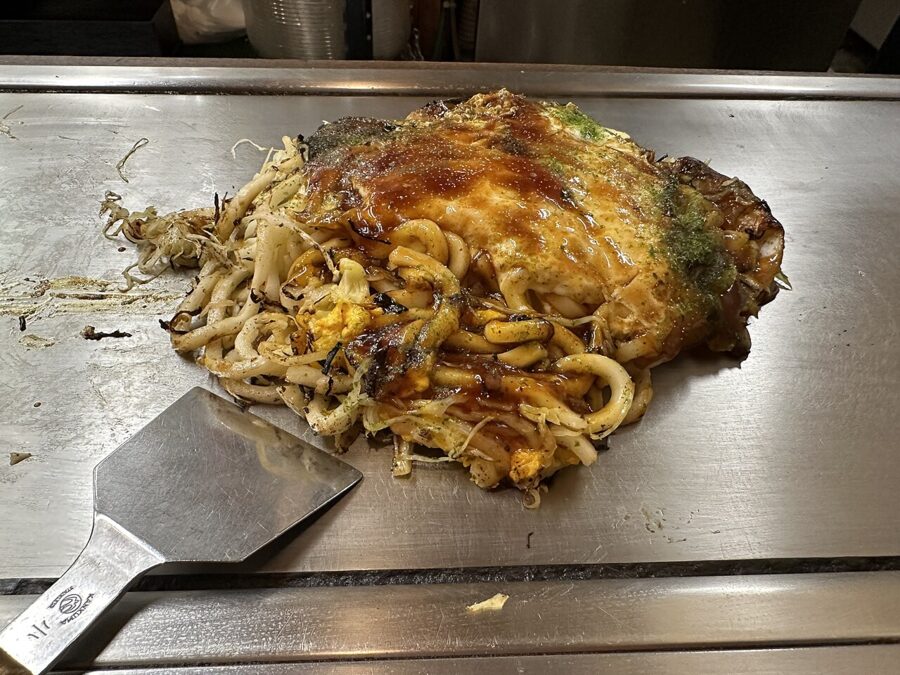
Hiroshima mixes nothing. A thin crepe goes down first, then a heap of cabbage, bean sprouts and sliced pork; the stack is flipped and pressed onto fried noodles and an egg. The prefecture’s own account traces it to issen yoshoku in the hungry years after the war; by about 1950 it was called okonomiyaki and had gained cabbage and Chinese noodles. Locals call it okonomiyaki, not “Hiroshima-style”.
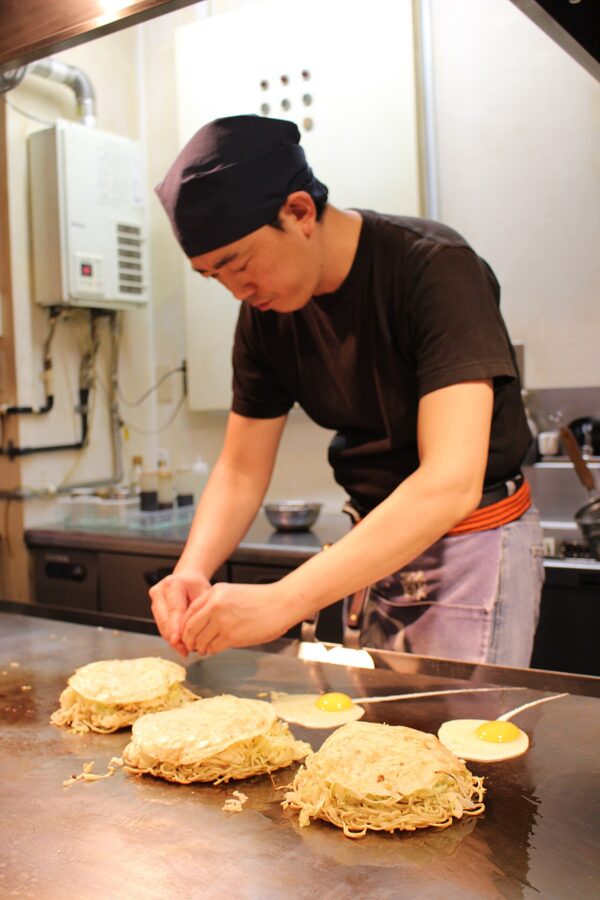

Order niku-tama-soba, pork, egg and soba noodles, the plain okonomiyaki in most Hiroshima shops. Udon is a common swap, some order double noodles, and rice on the side is rare. Like ramen, it changes from town to town: Fuchu uses minced meat, and Onomichi adds gizzards and fried squid.

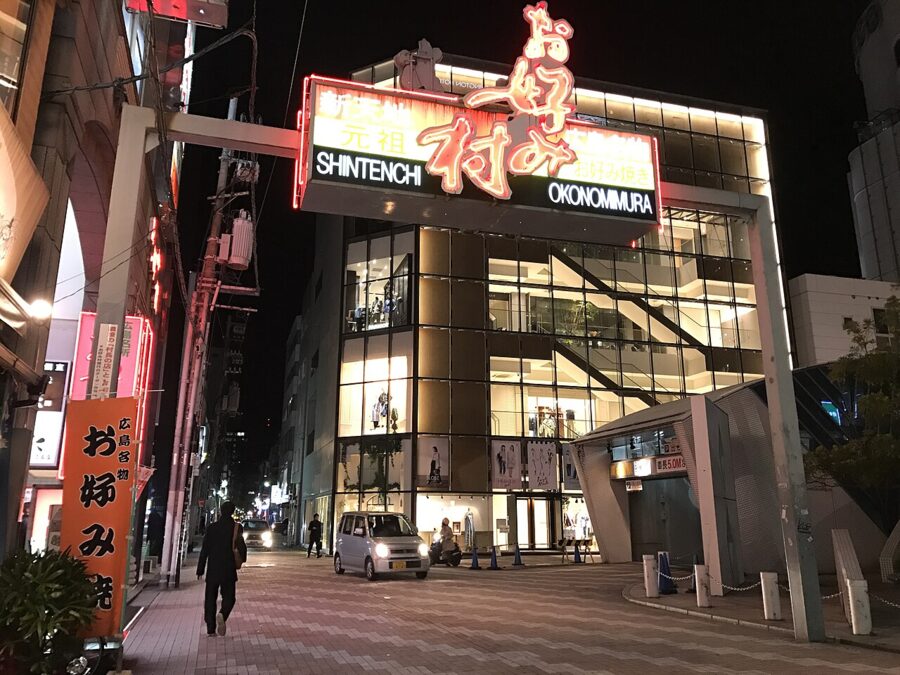
In Hiroshima, start at Okonomimura on Shintenchi. It began around 1950 as some fifty stalls on the Shintenchi square, moved indoors in 1963 and has filled its current building since 1992, with about two dozen counters on floors two to four. Many stay open from lunch until late, so a late-afternoon visit avoids the queue.

Monjayaki, the Tokyo cousin
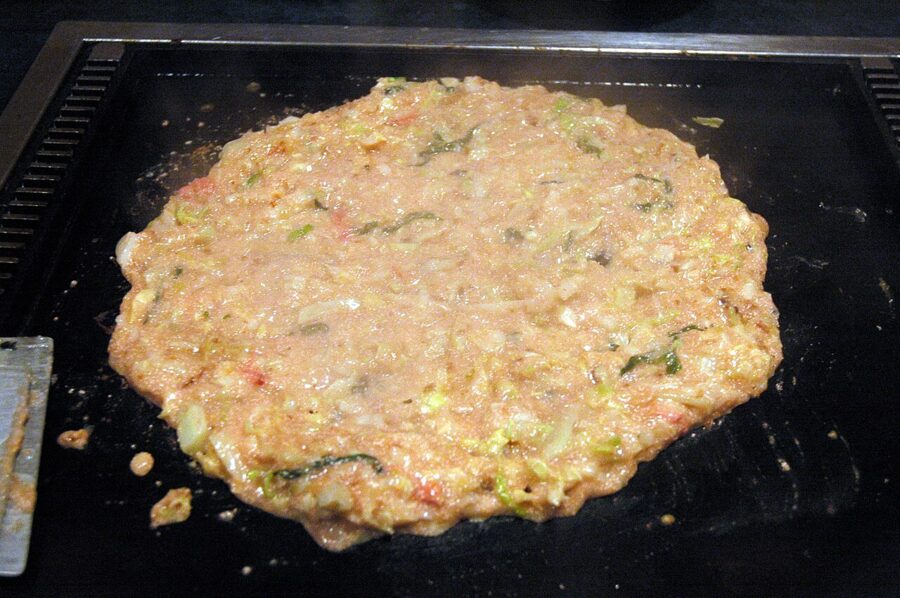
Tokyo’s branch went the other way. The monji-yaki sweet shops cooked for children took on more and more water until it became monjayaki (もんじゃ焼き), a loose batter that never sets. You fry the fillings in a ring, pour the liquid into the middle, stir, and eat it off the griddle with a tiny spatula once it browns.
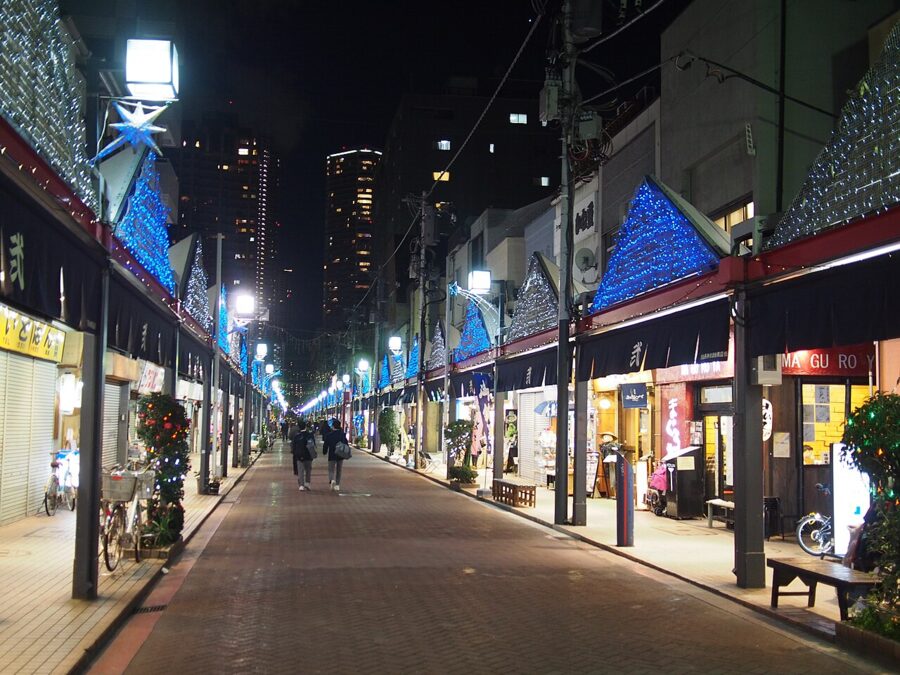

It looks alarming and tastes of toasted, savory crust. Eat it in Tsukishima, near Tsukishima Station, where the Tsukishima Monja association has about fifty member shops. Mentaiko, mochi and cheese is a common first order.

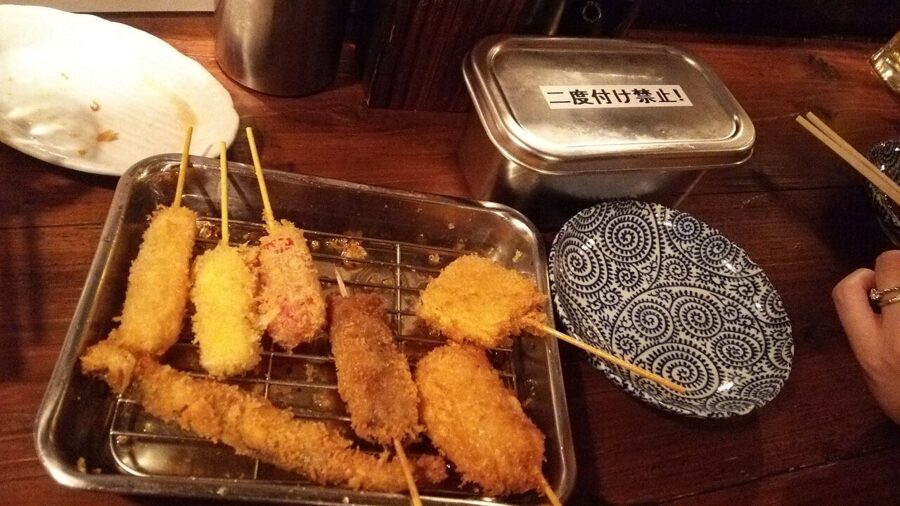
Kushikatsu and the no-double-dipping rule
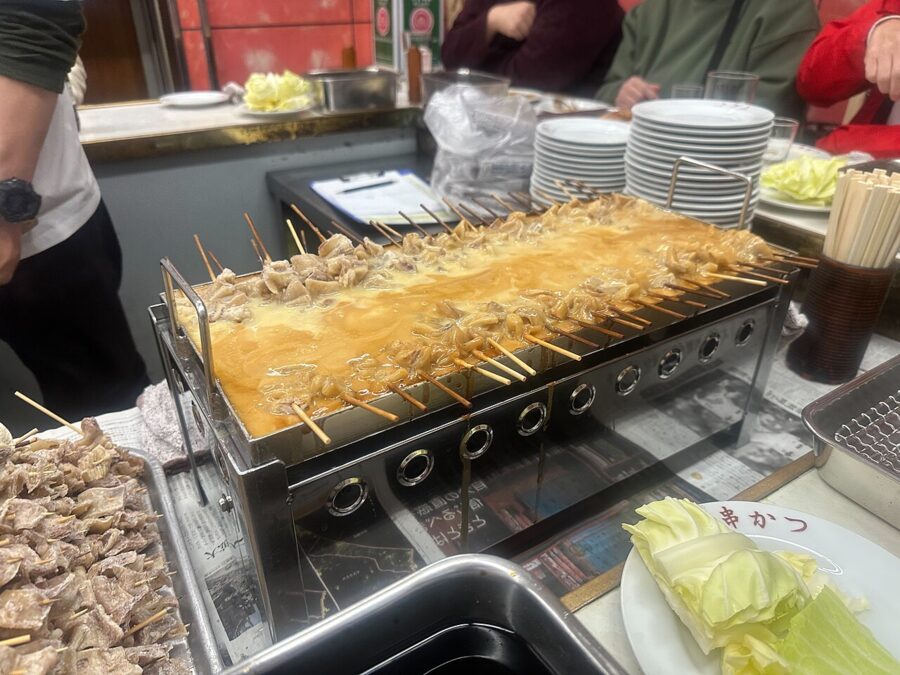
Kushikatsu (串カツ) are skewers of meat, seafood and vegetables in fine batter and crumbs, deep-fried and eaten at a counter as fast as they leave the oil. Shinsekai claims them. Kushikatsu Daruma dates itself to 1929, when Yoshie Momono opened a stall called Takohishi on the old Luna Park grounds, frying skewers of beef, then a luxury, when a skewer cost one sen. The menu had two items: beef and potato.

The shop burned in the first air raid on Osaka. Masao Momono, the second owner, reopened it after the war as Daruma and added doteyaki (どて焼き), beef tendon stewed in sweet miso, and free raw cabbage. In 2001 the ailing third owner planned to close, until the actor Hidekazu Akai, a regular since childhood, persuaded him to pass it to Katsuya Kamiyama, still the chairman.

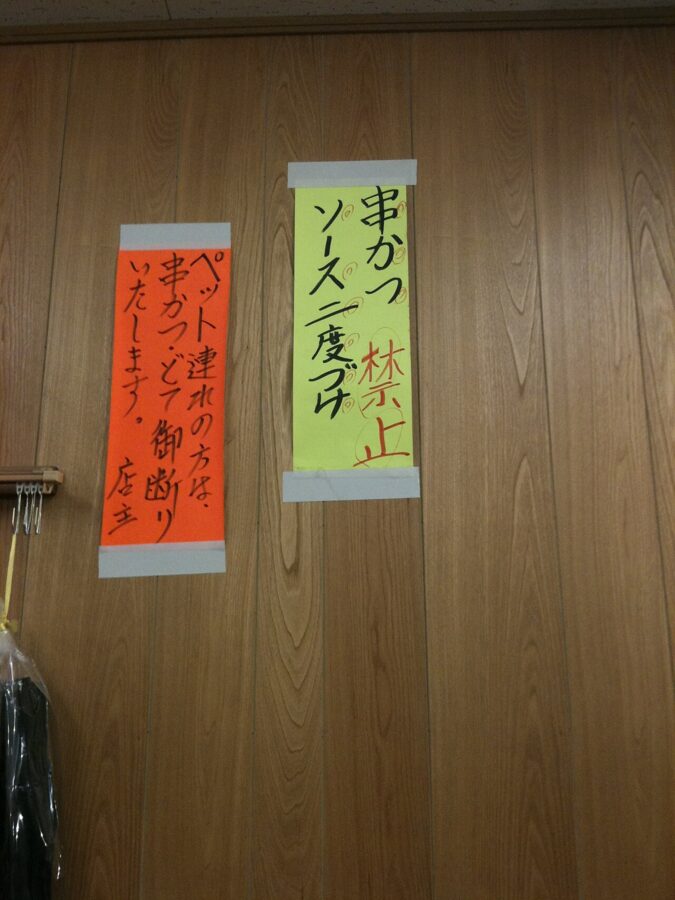
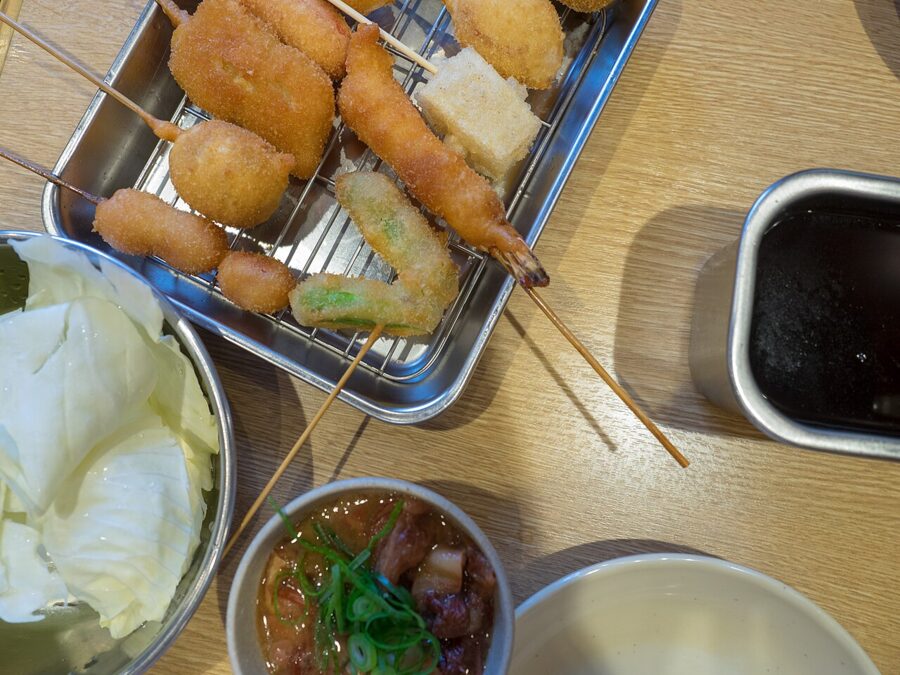
The rule is nidozuke kinshi (二度づけ禁止), no double dipping. The thin, tangy sauce sits in a shared steel tin, and you dip each skewer once, fully, before the first bite. For more sauce later, scoop it with a cabbage leaf and pour it over; the cabbage is there for exactly that.

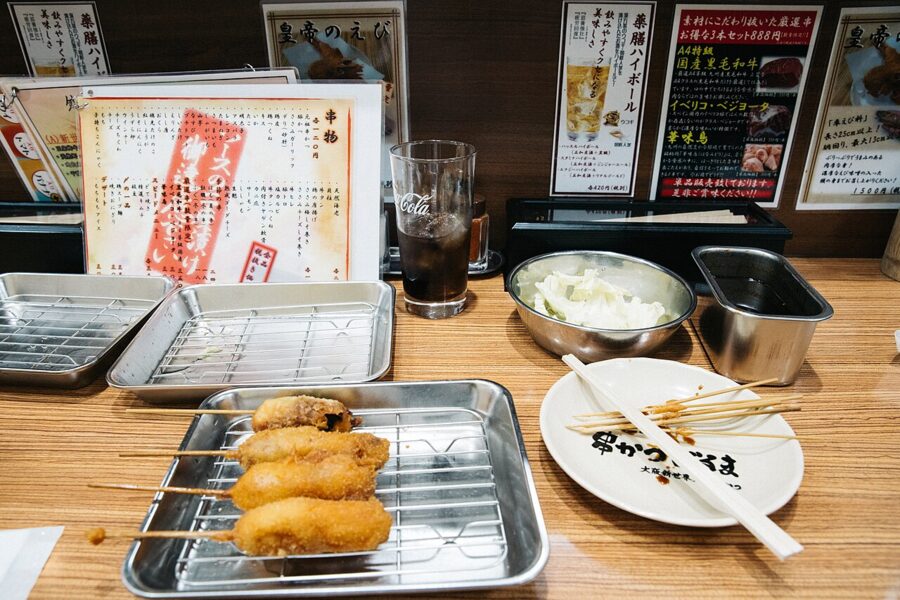
Daruma’s Shinsekai main shop at Ebisu-higashi 2-3-9 is a 12-seat counter with no reservations, open 11am to 10:30pm on weekdays and from 10:30am on weekends and holidays. As of 2026 the shop puts the usual spend at ¥1,500 to ¥2,500 (about US$10 to US$16) a person and asks for one drink each. Start with beef and doteyaki, then order by the piece.

Daruma has more than a dozen branches, including Dotonbori, Hozenji and Umeda. The company has warned about lookalike bars in Shinsekai and Namba, so check the name on the sign.

The rest of the street: ikayaki and 551 butaman
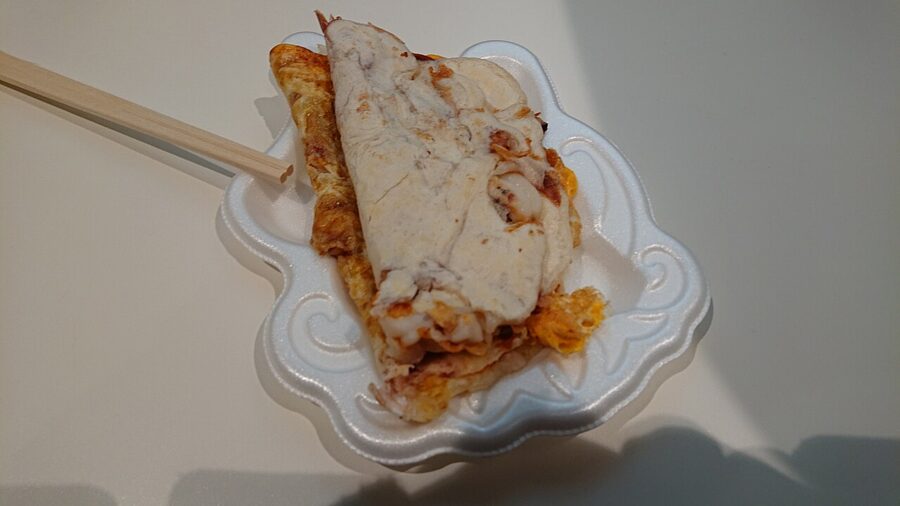
Osaka ikayaki (いか焼き) is not a whole grilled squid. It is thin batter with pieces of squid, cooked flat, brushed inside with sweet-savory sauce and folded. The famous one is Hanshin Meibutsu Ikayaki, in the Snack Park food hall in the basement of the Hanshin Department Store in Umeda.


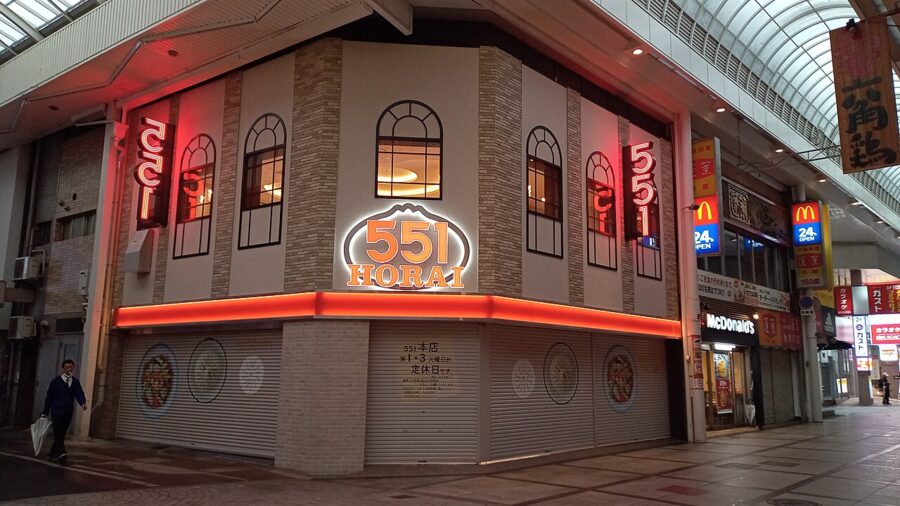
The other thing Osaka carries home in a paper bag is the butaman (豚まん, pork bun) from 551 Horai: hand-wrapped, filled with diced pork and onion in a lightly sweet dough, about 170,000 sold a day. Prices rose on September 1, 2026; a box of two now costs ¥500 (about US$3), and ten cost ¥2,500 (about US$16).

Where to go
| Area | Eat | Station |
|---|---|---|
| Dotonbori, Sennichimae | Takoyaki, okonomiyaki, butaman | Namba |
| Kuromon Market | Takoyaki, seafood | Nipponbashi |
| Shinsekai | Kushikatsu, doteyaki | Ebisucho, Dobutsuen-mae, Shin-Imamiya |
| Tsuruhashi | Okonomiyaki, yakiniku | Tsuruhashi |
| Umeda, Juso | Ikayaki, negiyaki | Umeda, Juso |
| Tamade | Aizuya takoyaki | Tamade |
Dotonbori and Namba, and the crowds
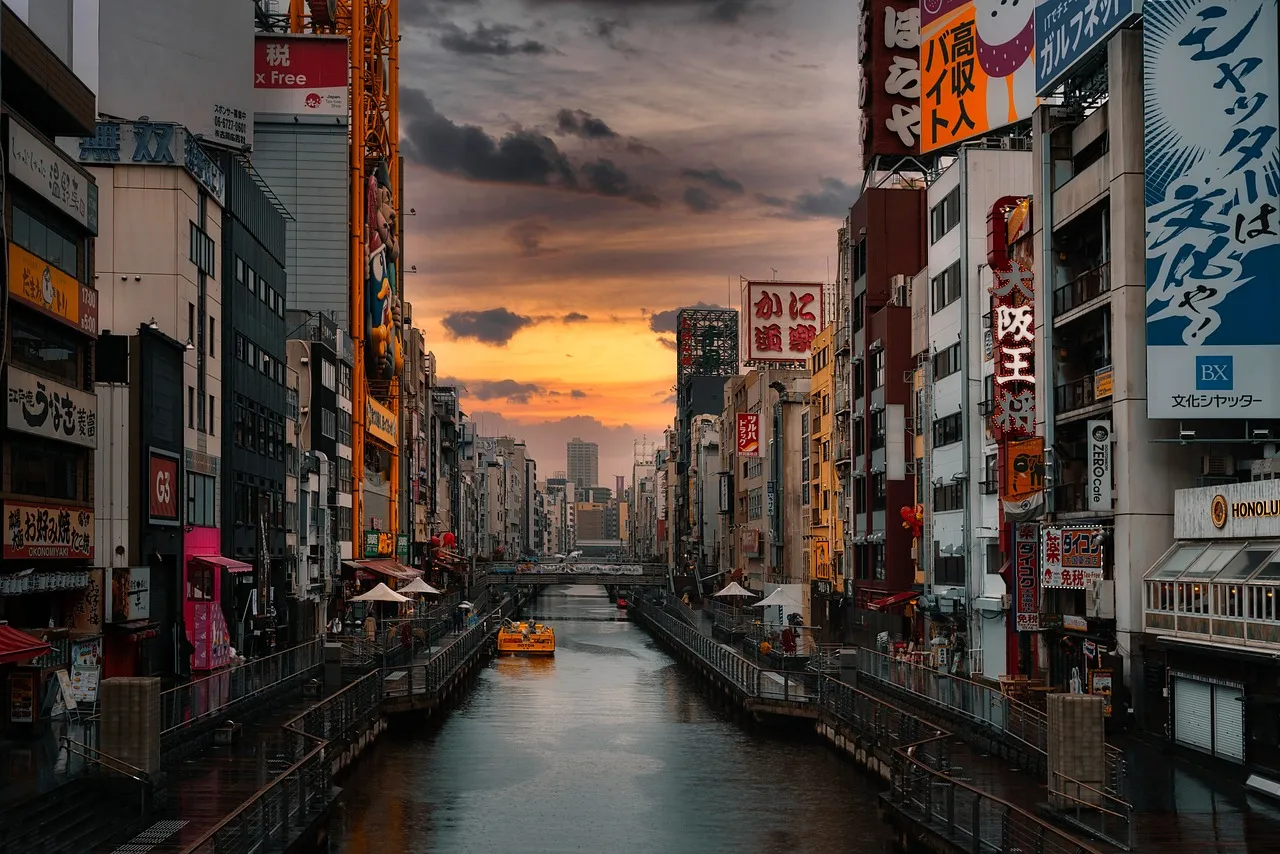
Dotonbori holds most of the famous takoyaki and okonomiyaki shops and most of the visitors, so the canal street is packed from late afternoon. Go before noon, or after 9pm when the crowd thins and the griddles are still hot. Just south, Hozenji Yokocho is a stone-paved alley of small restaurants with a much quieter feel.
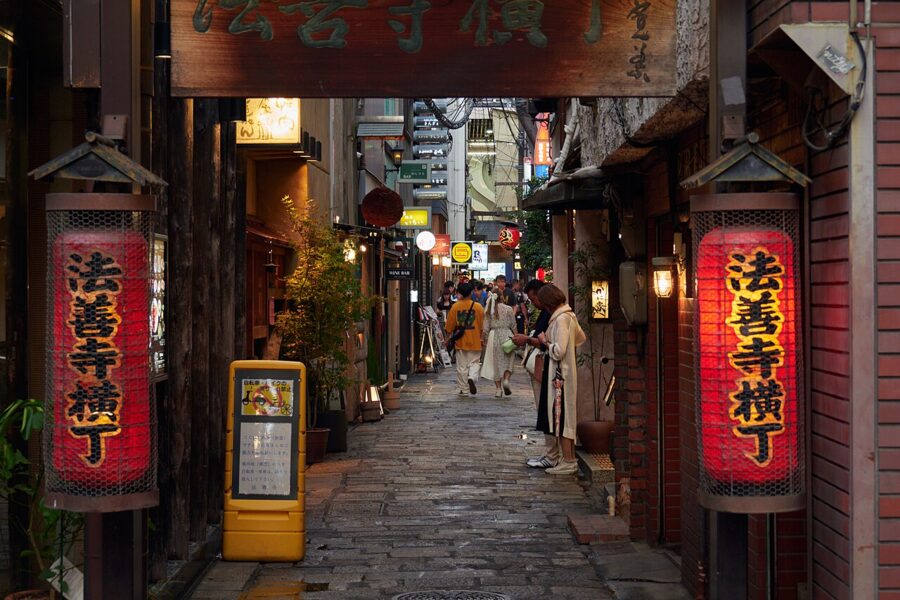
Smoking on the street has been banned across Osaka since January 27, 2025, with a ¥1,000 (about US$6) fine; a new smoking area opened beside Tazaemon Bridge in February 2026. Public bins are scarce, so eat at the stall and leave the boat in its bin.
Kuromon Market
Kuromon Market runs about 580 meters south from Sennichimae, with around 150 shops. It dates to about 1822, when traders gathered by the black gate of Enmyoji temple to sell fish from Sakai and Kishu. It sees about 18,000 visitors on a weekday and up to 150,000 in the days before New Year.
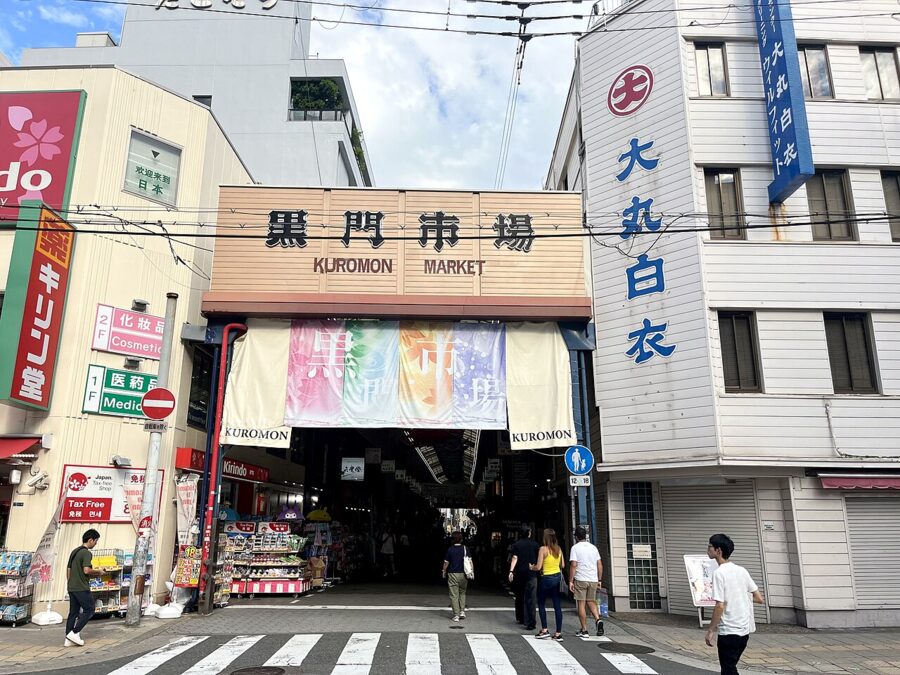
Today it is as much for grazing as shopping: takoyaki, grilled scallops, tuna skewers and sushi cut to order. Prices have risen with its fame, so set a budget. Each shop keeps its own hours and many wind down by early evening.
Shinsekai
Shinsekai grew on part of the site of the 1903 National Industrial Exposition, around the first Tsutenkaku tower and the Luna Park amusement grounds. Both are long gone, but the streets beneath today’s Tsutenkaku are lined with kushikatsu shops, oversized signboards and a giant pufferfish lantern.
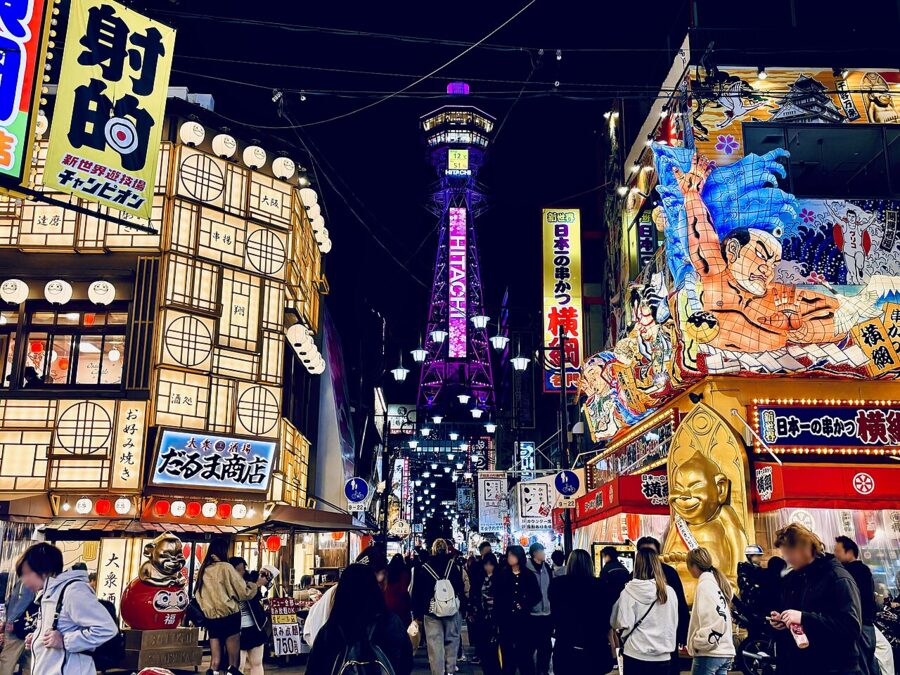
Janjan Yokocho, the narrow covered street toward Dobutsuen-mae Station, holds the older counters. Weekday lunch is the calmest time.

Tsuruhashi
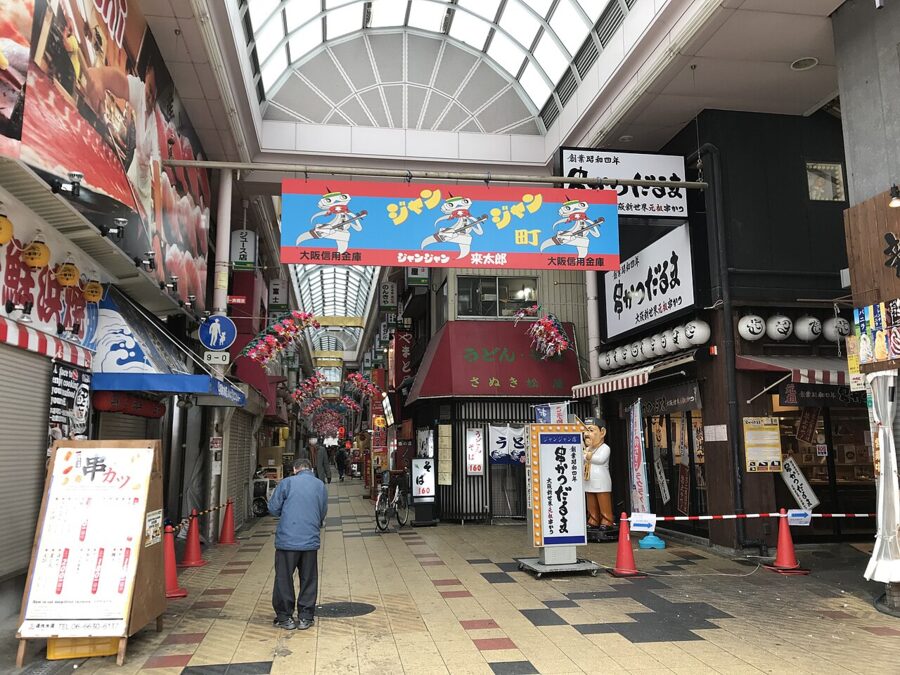
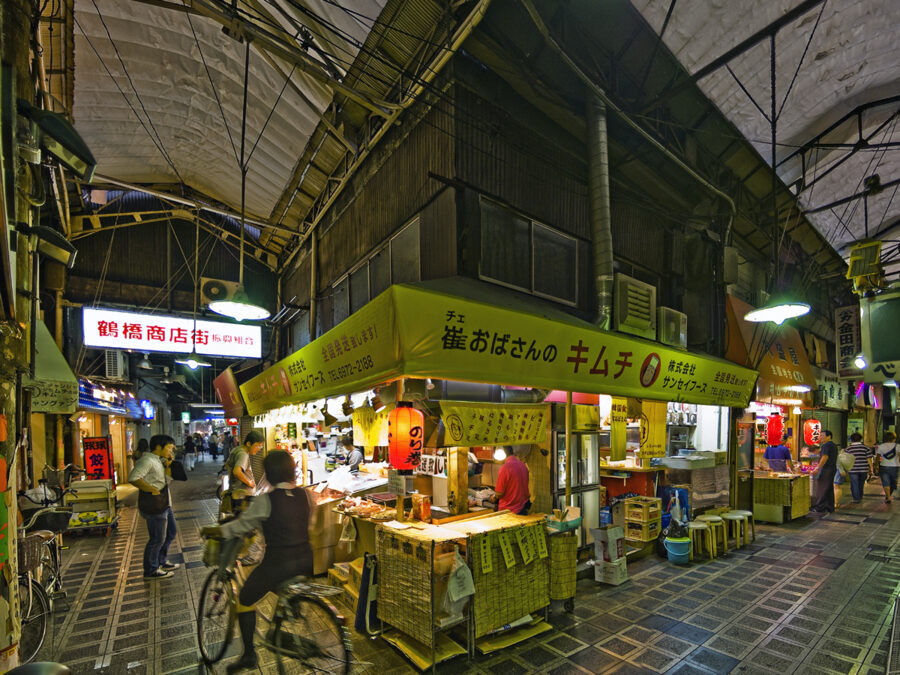
Tsuruhashi, on the Osaka Loop Line, grew from a postwar black market of some 3,000 street sellers, and its maze of covered lanes still starts at the station exits. It is the edge of Osaka’s Korean neighborhood, with yakiniku smoke, kimchi shops and Korean pancakes. Tsuruhashi Fugetsu, one of the big Osaka okonomiyaki chains, started here.

Prices as of 2026
| What | Where | Price |
|---|---|---|
| Plain takoyaki, 12 | Aizuya | from ¥550 |
| Butaman, box of 2 | 551 Horai | ¥500 |
| Kushikatsu, per person | Daruma, Shinsekai | ¥1,500 to ¥2,500 |
| Takoyaki course | Konamon Museum | ¥3,850 |
| Takoyaki hall | TAKOPA | free entry |
Sit-down okonomiyaki prices vary by shop and change often, so read the board outside before you sit. A crawl of a takoyaki boat, a butaman and a few skewers still costs less than one restaurant dinner.
Next time the cook flicks a half-set ball over and the raw batter runs into the mold, you will know the trick is ninety years old and began with a remark about Akashi octopus. Buy one boat, eat it at the stall, and walk to the next.